

As a school counselor, I see one of the most prevalent things is that children will go to “happy,” “sad,” or “mad” when asked to describe emotions. Although these are basic feelings, restricting their emotional vocabulary actually serves to restrict their capacity to deeply know themselves, express their needs, and navigate the subtleties of their inner life. Consider this: if a grown-up had only three words to explain their day, how would they do at explaining frustration nuances, surprise, or satisfaction? Same for children. If young kids don’t have words to explain what is happening inside, those unwritten feelings may manifest in other ways — withdrawal, out-of-the-blue meltdowns, or even complaints of sickness.
The Power of Precise Language
Assisting children towards a more robust emotional vocabulary is not necessarily about learning more words; it’s about enabling them. When a child can state that they’re “frustrated” rather than simply “mad,” it’s a great step in the direction of self-awareness. They recognize that feelings are unique, convey meaning, and can be managed. This accuracy is the building block for:
Self-Regulation: Knowing the exact feeling is the initial step in selecting a suitable coping mechanism.
Empathy: Having knowledge of their own emotions, they can empathize and walk in other people’s shoes.
Problem-Solving: Emotional expression is capable of resolving problems and communicating needs constructively.
Resilience: The fact that feelings are fluctuating instead of being smothering creates emotional resilience.
How to Help Kids Expand Their Feelings Dictionary
So how do we, the parents and teachers, motivate our children beyond the novice level?
Model Emotional Vocabulary: Label your own feelings using genuine words. “I’m frustrated with this puzzle as well,” or “I’m proud of you for trying!”
Narrate and Validate: When describing a child’s behavior, just pose a feeling. “It seems you were disappointed when the game was finished.” Always validate: “It is okay to be disappointed.”
Model the emotional vocabulary and validate the feeling.
Read Children’s Books About Feelings: There are just so many great children’s books that address so many various feelings and put them within a child’s grasp.
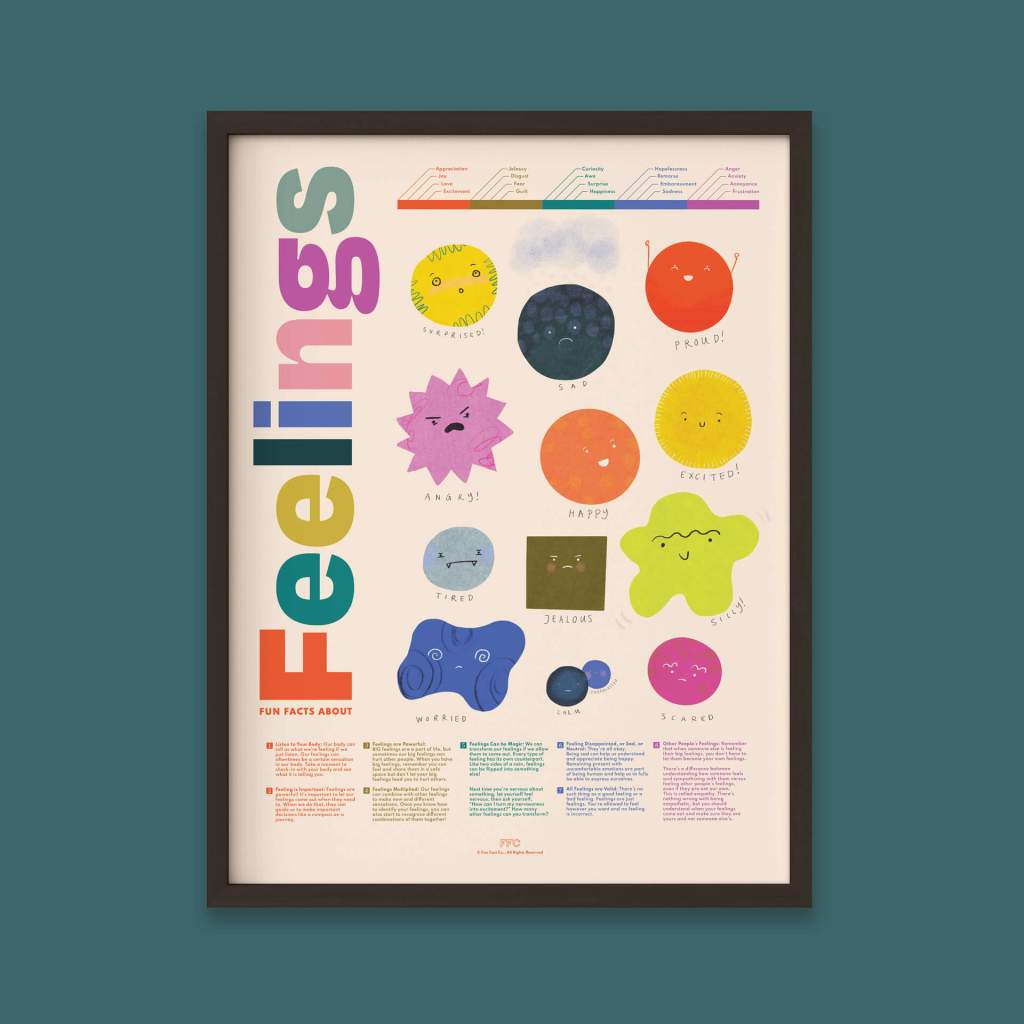
Use Visual Aids: This is where a really great tool comes in handy! Kids are visual, and being able to see all kinds of faces and scenarios can call forth needed discussions. A feelings poster or chart can be a daily conversation opener. As an example, we strongly recommend the ‘Feelings Fun Facts Poster’, its colorful pictures and rainbow-hued range of feelings, let alone those genuinely interesting ‘fun facts’ at the end, make it a great addition to a bedroom, playroom, or classroom. It’s a superb, interactive way for children to observe and talk about feelings beyond happy, sad, and angry.
Play Feelings Games: Charades, drawings of feelings, or guessing games are all fantastic methods of learning about feelings in a vibrant and energetic way.
By consciously broadening the range of a child’s feelings, we arm them with life tools that are extremely potent. We make them transform intangible inner feelings into tangible, concrete pieces of themselves, in preparation for higher emotional health and closer relationships.
Disclosure: This article contains affiliate links. If you purchase a product through one of my links, I may receive a small commission at no extra cost to you.

 officialguidedgrowth.com
Leave a comment